Delivering to Alaska
Dolphin FIS Therapy Surfaces in Alaska
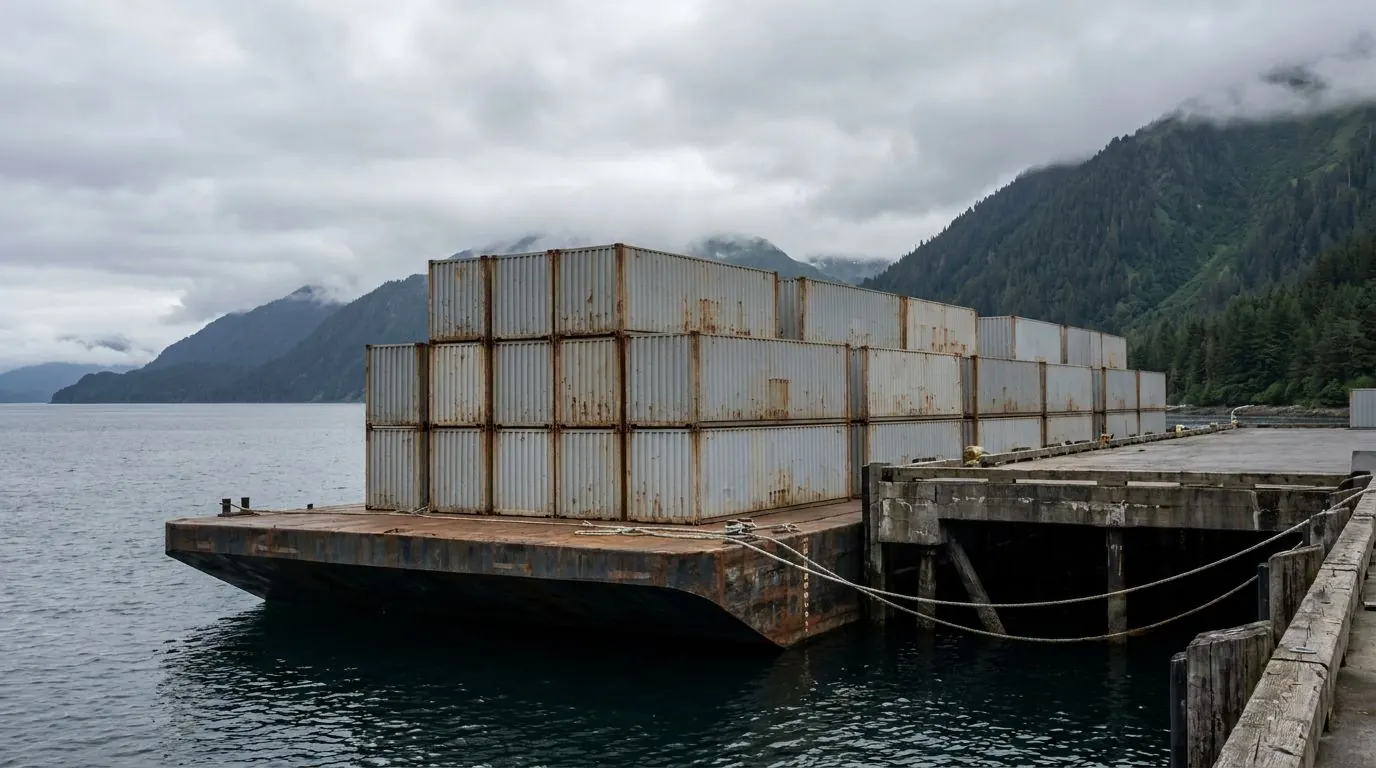
There is no truck route from the lower 48 to Alaska that does not cross Canada, and for most freight that is not the route anyway. What reaches Alaska reaches it by sea or by air: containers sailing north from Puget Sound to the Port of Alaska at Anchorage and to the Southeast ports, and air cargo for everything that cannot wait for a sailing or cannot get there any other way. Then, for a great many Alaskan addresses, there is a second leg after that one, because Anchorage is where the freight lands, not where the patient lives.
So the honest headline for this page is a lead time measured in weeks rather than days, and the useful thing we can do is tell you which weeks and why, before you plan a discharge around them. We would rather lose an order to a supplier who promises faster than have a family in Bethel or Kotzebue arrange a homecoming around a date we invented. Dolphin FIS and Fluid Immersion Simulation are registered trademarks of Joerns Healthcare LLC; we are an authorized dealer and we are not Joerns.
Coming home from
-
A tertiary hospital in Anchorage
The state’s complex care is concentrated in one metro. Patients are routinely flown in from across Alaska for treatment and flown home afterwards, which means the discharging hospital and the delivery address are often a thousand miles and two freight legs apart.
-
A regional hospital serving a hub community
Fairbanks, Juneau, Bethel, Nome, Kotzebue, Dillingham, Sitka and Kodiak serve wide regions. A hub hospital is the end of the scheduled-flight network for the villages around it and the start of the bush leg home.
-
A village clinic on the Alaska Native health system
Many communities are served by a clinic staffed by community health aides with physician support at a distance. Equipment arriving into a village arrives without a technician alongside it, and the plan has to account for that from the outset.
-
A private home on the road system
Anchorage, the Mat-Su Valley, the Kenai Peninsula and Fairbanks are reachable by truck once freight has landed, and behave much like a mainland delivery from that point on.
-
A private home off the road system
Reached by air year-round and by barge in the ice-free season. This is where the schedule stops being about us and starts being about sailings, weather and daylight.
Going home to Alaska
Work backwards from the sailing, not forwards from the order. For an address on the road system — Anchorage, Wasilla, Palmer, Soldotna, Homer, Fairbanks — the journey is an ocean leg to Anchorage and then a road leg, and the variable is which sailing the freight makes. Miss one and you are waiting for the next, which is not the same kind of delay as missing a truck. For an address off the road system, add a second leg after Anchorage, by scheduled air freight or by barge, and the barge is seasonal: the western and northern coastal and river communities are served during the ice-free months and not outside them. Juneau is worth naming on its own, because it is a state capital with no road connection to the rest of North America and everything arriving there arrives by water or by air.
The other thing to plan for is what "setup" means here, because it does not mean the same thing it means in Ohio. In much of Alaska nobody is going to arrive alongside the shipment. The realistic arrangement is that a family member, a home health nurse or clinic staff do the setup, with us and the manufacturer’s documentation walking them through it, and with the frame measured and confirmed before anything leaves the mainland rather than after it lands. We will say clearly which of those applies to your address before you order. We are not going to advertise white-glove delivery to a village we cannot send a person to.
Homes here, and what fits in them
Once the freight is at the door, an Alaskan home is generally not a difficult delivery. What is difficult is the door’s relationship to everything else. Houses in many communities are built on piles above permafrost with an exterior stair and an arctic entry, and the arctic entry — a small unheated vestibule — is exactly the place a delivery gets left and exactly the wrong place for it. Joerns states the system’s storage and shipping conditions as an ambient 50 to 104 degrees Fahrenheit. An arctic entry, an unheated warehouse at a hub airport, or a pallet on an airstrip apron in February is far below the bottom of that range, and the handover has to be to a person who takes the equipment into the heated part of the building.
Power is the second consideration and it is not the same as it is down south. Many rural Alaskan communities run on an isolated diesel microgrid, and an outage in a community like that is not a matter of a crew driving out from the next town. Joerns states that the battery back-up supplies the control unit for approximately twelve hours when power fails, and recharges once power returns. Twelve hours is a genuinely useful margin against a village outage. It is not a plan for a prolonged one, and the care team should know what the fallback is before the system is in the house rather than after.
Most requested in Alaska
Standard Dolphin FIS Mattress
One 22 lb mattress and one 10 lb control unit is the smallest complete system there is. On a route where every additional piece is another freight decision and possibly another sailing, the simplest configuration is the one that arrives soonest.
$X,XXX–$Y,YYY/mo
Low-Profile Dolphin FIS System
Joerns describes a foam safety cell on Low Profile models as protection against bottoming out during a power failure that outlasts the battery. In a community on an isolated diesel grid, where a crew cannot simply drive out from the next town, that is a specification worth asking the care team about.
Call for a quote
Pediatric & Crib Dolphin FIS Systems
Children from across Alaska are treated in Anchorage and flown home. The crib and pediatric surfaces are the smallest and lightest items we ship, which is exactly what you want when the last leg of the journey is a small aircraft.
Call for a quote
Discharge coming up
Coming home from hospital in the next day or two?
Send us a note with the discharge date and the surface the care team has recommended, whether the patient is leaving a hospital, a rehabilitation facility, a skilled nursing facility or hospice care. What can arrive in time depends on stock, the freight lane and the hour you call, so the earlier the better.
Nearby areas we deliver to
Equipment rentals in Alaska: questions
Can you actually deliver to Alaska, and how long does it take?
Why would the control unit and the mattress ship differently?
Will someone come and set it up?
Our village is served by barge. Does it matter when we order?
It is well below freezing here. Is it safe for the equipment to travel?
What happens at the end of a rental?
Book a rental delivered to Alaska
Tell us the address, the date and what the care team recommended. We confirm stock, the monthly rate and a delivery window by phone.