Delivering to West Coast
Dolphin FIS Therapy Surfaces on the West Coast
Everywhere else on this map, a power cut is something that happens to you. Here it is something that is announced. Utilities in California and Oregon de-energise circuits deliberately during high fire risk, with notice, sometimes for more than a day, and that makes the West Coast the only region where the outage question has a calendar attached to it. For a family running mains-powered therapy equipment at home, that is genuinely better than an unannounced failure — you can plan against a notice — but only if somebody has the conversation before the notice arrives.
Here is the part that has to be said plainly. Joerns states that the battery back-up supplies the control unit for approximately twelve hours when power fails or the system is disconnected. A planned shutoff can run longer than twelve hours. So the battery is what carries you through the start of an event, not through the event. The power plan — what the alternative is, who is called, and whether the person needs to be somewhere else — belongs to the care team and the family, and it belongs in the diary before fire season rather than during it. Dolphin FIS and Fluid Immersion Simulation are registered trademarks of Joerns Healthcare LLC; we are an authorized dealer and we are not Joerns.
Coming home from
-
A private home running complex care
This region supports more people with high-acuity needs at home than any other, and California runs an unusually large publicly funded in-home care program. The home is the primary care setting here, not the fallback.
-
An academic medical center on the I-5 corridor
Seattle, Portland, the Bay Area, Sacramento, Los Angeles and San Diego. Ordinary freight lanes at both ends, and discharge planning that is used to sending complex patients home.
-
A skilled nursing or subacute facility
Dock receiving and a scheduled window. Facility generator arrangements also mean the outage planning here is the facility’s rather than the family’s.
-
A home in a designated high fire-hazard area
Where planned de-energisation is most likely and evacuation orders are a live possibility. The delivery conversation and the contingency conversation are the same conversation.
-
A rural home on the North Coast or east of the Cascades
Humboldt, Mendocino, Siskiyou, eastern Oregon and eastern Washington are a different freight picture from the corridor — long final legs and routes that close for slides and snow.
Going home to West Coast
The freight half of this is the easy half. The I-5 corridor from Seattle to San Diego is one of the best-served lanes in the country, terminals are close together, and for the large majority of addresses on this coast the truck is not the constraint. Where that stops being true is off the corridor: the North Coast up Highway 101, the far northern counties, the Sierra foothills, and everything east of the Cascades. Those addresses behave more like the ones described on our Mountain West and High Plains page, with longer final legs and routes that close for slides in winter and for fire in summer.
The part worth doing early is not the freight, it is the utility. If someone at the address depends on powered medical equipment, it is worth asking the utility directly about its medical baseline program and about getting onto the advance-notification list for planned shutoffs. That is the utility’s process and its decision, not ours — we cannot enrol anyone or promise an outcome — but being on a notification list is the difference between two days of warning and none. Ask early, because enrollment is paperwork and paperwork is slower than a fire weather forecast.
Homes here, and what fits in them
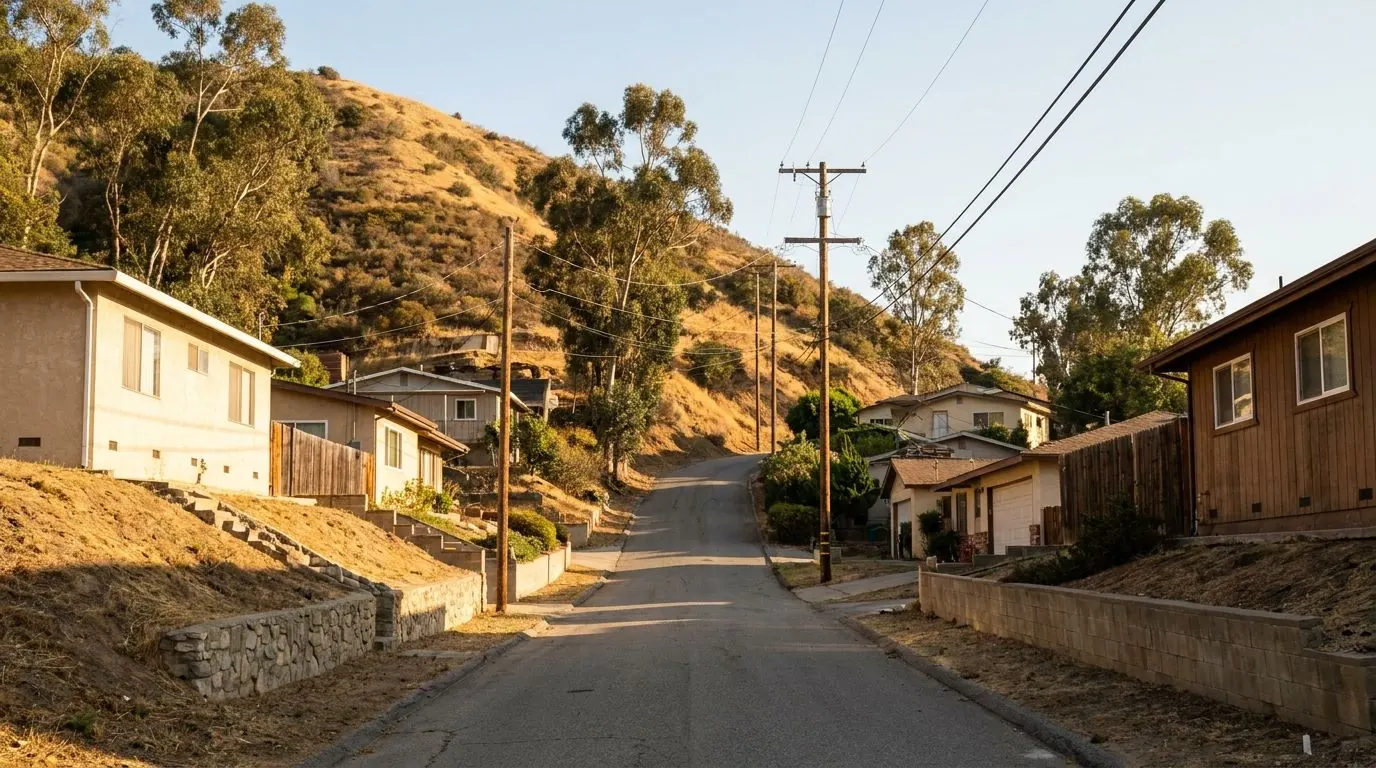
The buildings here are more varied than anywhere else we deliver, and the pattern that recurs is the exterior stair. San Francisco and Seattle hillside homes put a flight of steps between the street and the front door with no driveway at the top. Los Angeles canyon houses do the same in reverse, with the living floor below the road. Converted garages and accessory dwelling units are used as care rooms across the region far more than elsewhere, which is usually good news — level entry, wide door — with one caveat, which is that a converted garage is often on a single circuit shared with a laundry. Tell us the route from the street, including the number of steps, before the day.
The other regional reality is that the equipment may have to leave. Evacuation warnings and orders in fire season are not rare events here, and a therapy surface is not something a family should be improvising about at two in the morning with a go-bag in the hall. What we ask people to settle in advance is simple: who moves the person, whether the system goes with them, and where it goes. The system itself travels better than most medical equipment — Joerns lists the mattress at 22 lb and the control unit at 10 lb, and states that the battery supports active therapy during patient transport — but the decision about whether moving the patient at all is appropriate belongs to the clinician, not to us and not to a website.
Most requested in West Coast
Standard Dolphin FIS Mattress
The 35-inch surface is what most home decks on this coast are built for, and the 22 lb mattress and 10 lb control unit are the reason a setup works in a hillside house reached by an exterior flight of steps.
$X,XXX–$Y,YYY/mo
Low-Profile Dolphin FIS System
The configuration Joerns describes as carrying a foam safety cell against bottoming out during a power failure that exceeds battery life. In the one region where outages are scheduled in advance, that is a specification families ask about by name — while understanding it is a limited protection, not continued therapy.
Call for a quote
Dolphin Wheelchair & Stretcher Seating Pads
This region supports more people living at home with high-acuity needs than any other, and for many of them the majority of waking hours are spent in a chair rather than in bed. A seated surface covers the part of the day a mattress cannot.
Call for a quote
Discharge coming up
Coming home from hospital in the next day or two?
Send us a note with the discharge date and the surface the care team has recommended, whether the patient is leaving a hospital, a rehabilitation facility, a skilled nursing facility or hospice care. What can arrive in time depends on stock, the freight lane and the hour you call, so the earlier the better.
Nearby areas we deliver to
Equipment rentals in West Coast: questions
Our utility runs public safety power shutoffs. Can we still use this equipment at home?
Would a generator or a home battery run the control unit?
What if we are evacuated while the system is on rental?
We are in Humboldt County, not the Bay Area. Is delivery the same?
The care room is a converted garage. Does that cause problems?
Book a rental delivered to West Coast
Tell us the address, the date and what the care team recommended. We confirm stock, the monthly rate and a delivery window by phone.