Delivery, fit and cleaning
Delivered, fitted to the frame, and removed sanitized
A therapy surface is only therapeutic if it fits the frame it is lying on. That sentence sounds like a sales line until you read what Joerns actually writes about gaps between a mattress and a bed’s panels and rails, and then it stops being a line and becomes the reason this page exists.
Everything below is about the three points where a surface can go wrong outside of the clinical decision: whether it fits, whether it was set up correctly, and what condition it was in when it arrived. We measure before we ship, we set it up rather than leave it in a carton, and we clean and inspect every surface between deployments.
- Widths
- 35, 42 and 48 inches
- Lengths
- 82 inches, 88 for step-deck, 80–92 expandable
- Depths
- 8 inches or 10 inches, depending on the model
- Fit rule
- No gaps at the head panel, foot panel or rails
From measurement to handover
- 1
Measure the frame
The usable deck width and length of the bed frame, and its rated load. Not the mattress currently on it, and not the size printed on a box in the garage.
- 2
Match the configuration
We pick the width, length and depth that sits on that frame without leaving gaps, and check the capacity against the patient’s weight and the frame’s own limit.
- 3
Check the route in
Stairs, elevators, corners, door widths, dock access. The surface is light but it is 82 inches or more of awkward, and the control unit needs a place to live beside the bed.
- 4
Deliver and set up
Carried in, laid on the frame, hoses connected, control unit sited and plugged into a dedicated outlet, system powered up and checked before anyone leaves.
- 5
Handover
Whoever is caring for the patient is shown the controls, the comfort adjustment, the CPR deflation valve, the storage switch and what the system does when the power goes out.
- 6
Collection and cleaning
At the end, we collect the surface and the control unit. Cleaning and inspection happen on our side, not in your house and not by you.
Will it fit my hospital bed?
Usually yes, and the reason to check rather than assume is specific. Joerns writes that the risk of entrapment arises when equipment is placed on bed frames that leave gaps of even a few inches between the therapy mattress and the head panel, foot panel, and bed or side rails — and that the equipment is not to be used when such gaps are present. That is not a recommendation about comfort. It is a statement that a badly fitted surface should not be in service.
The sizes are fixed, which makes the check straightforward. Surfaces come in 35, 42 and 48 inch widths and 82 inch lengths, with an 88 inch length for the step-deck configuration and an expandable model Joerns rates from 80 to 92 inches. Depth is 8 or 10 inches depending on the model, which changes how far the surface sits above the frame and therefore how much of the side rail is left standing proud. A 35 inch surface on a 36 inch frame is a clinical question, not a rounding error.
So we ask for the frame’s make and model, or a measurement of the deck itself, before anything is quoted. If the numbers do not work, we say so and we do not ship. That occasionally means telling someone their frame needs to change before the surface can be used, which is an unwelcome sentence to hear and a much better one than the alternative.
- Measure the deck the mattress sits on, not the outside of the frame
- Measure the length between the head and foot panels
- Note whether the frame is a step-deck or articulating design
- Note the frame manufacturer’s rated load capacity if you can find it
- Tell us about side rails: type, height, and how they sit against the current mattress
What "white glove" actually covers
It means the surface does not arrive as a carton on a driveway. It is carried into the room, laid on the frame, connected, powered and checked, and the people who will be living with it are shown how it works. What ships is light — Joerns lists the therapy mattress at 22 lb and the control unit at 10 lb — so this is not a job that needs a crew; it is a job that needs someone who knows what a correctly fitted surface looks like.
The handover is the part people undervalue at the time and remember later. The system is self-adjusting: Joerns states the AutoVector® control module monitors the support surface more than 100 times per second for patient movement or surface changes, and that no direct intervention is needed to adjust comfort settings. But there are still controls that matter at 3am. Autofirm, used for transfers and care procedures, which Joerns says returns to the previous setting automatically after approximately 15 minutes. The quick CPR deflation valve, which somebody should be able to find without reading a manual. The storage switch, which has to be in the battery-on position for the battery to recharge. And the manual comfort adjustment, which the control module re-optimizes around rather than overriding.
Joerns also instructs that after any comfort adjustment, the caregiver performs a hand check to confirm the patient is not touching the mattress support platform. We show that at handover because the manufacturer asks for it, not as a feature of ours.
How surfaces are cleaned between deployments
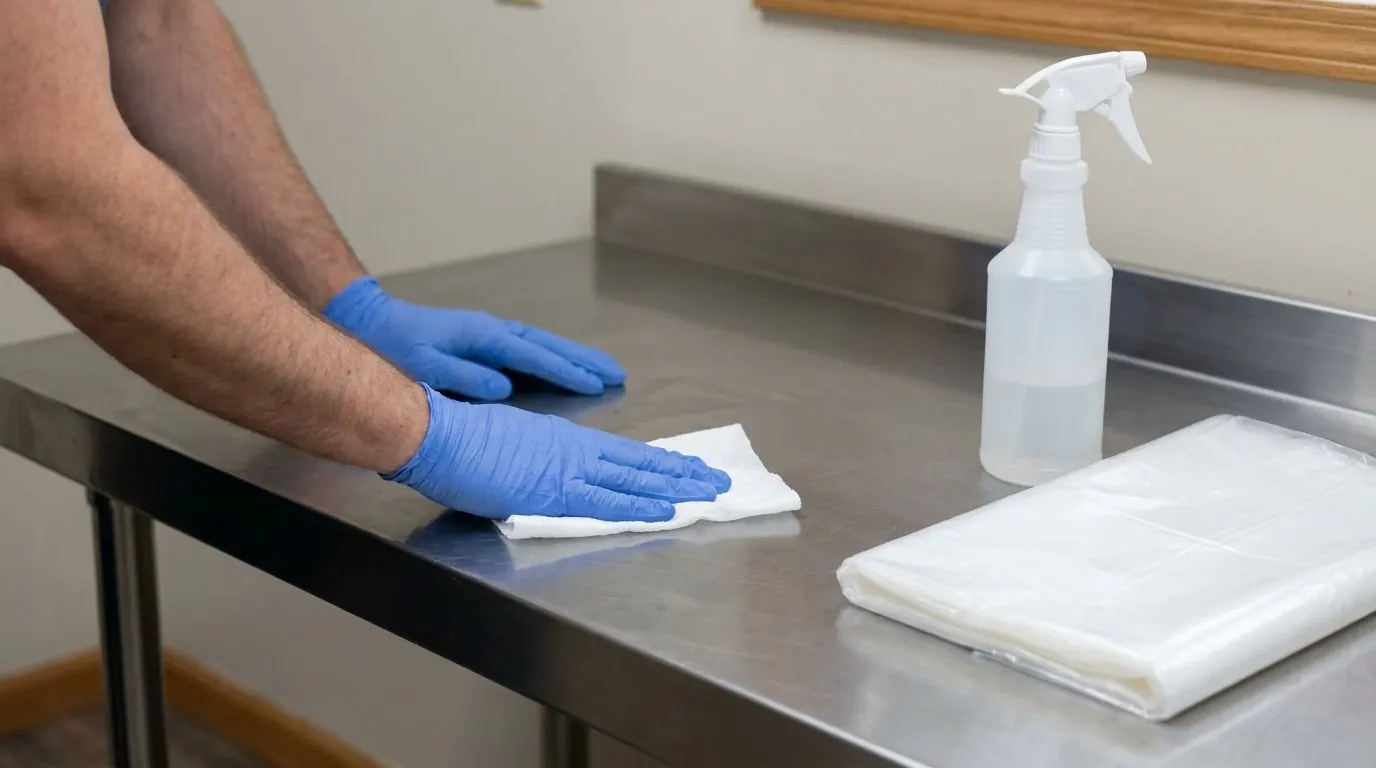
Every surface that comes back is cleaned and inspected before it goes out again, following the cleaning instructions Joerns publishes in the user-service manual for these systems. The therapy pad is a smooth nylon fabric with low friction and low shear properties, and it is breathable and moisture vapor permeable, which is what makes it cleanable in the way the manufacturer describes.
What we will not do is name a standard we do not hold. There is no certification, accreditation or numbered reprocessing protocol behind our cleaning, and you will not find one claimed anywhere on this site. Plenty of equipment suppliers cite impressive-sounding standards on their websites; if that matters to your facility’s infection prevention team, ask every supplier you are considering to put in writing exactly what they hold and who audits it, and read what comes back. Ours would say: manufacturer cleaning instructions, followed, with inspection, on equipment that was in one patient’s home and is going to another’s.
That is also why removal is our job rather than yours. A returned surface is handled by people who are expecting it, not bagged by a family in a hallway.
What the room needs before delivery day
The bed frame in the room where it will be used, assembled, with the current mattress off or ready to come off. An outlet for the control unit that nothing else competes for, near enough to the bed that the hoses reach without being stretched across a walkway. Space beside the bed for the control unit itself, which Joerns gives as 11.5 inches wide by 12.5 high by 6 deep.
And an indoor environment inside the range the equipment is rated for. Joerns gives an operating range of 50 °F to 95 °F with relative humidity of 30% to 75% non-condensing, and rates the enclosure IPX2 — which is a limited degree of protection against dripping water, not a device you can get wet. Storage and shipping are rated across a wider range, 50 °F to 104 °F, but that is the sealed carton in transit, not the system in service. An unconditioned sunroom, a garage conversion without heat, or a porch where a carrier might leave a shipment are all outside what the manufacturer rates.
- Frame assembled and in position, with the existing mattress ready to come off
- A dedicated outlet within reach of the bed
- Clear floor space for the control unit beside the frame
- A path in wide enough for an 82-inch surface to turn corners
- An indoor room between 50 °F and 95 °F
- Someone to receive the delivery and take the handover
Collection at the end
When the surface is no longer needed, tell us and we arrange collection. Nobody should be trying to work out how to return a therapy surface in the week after a patient has died or moved to a facility, and nobody should be storing one in a spare room because they were not sure whether to call.
Keep the hoses, the power lead and the control unit together — those three are the pieces most likely to end up in a different room — and leave the surface where it is. We take it from there. If there is anything that needs saying about the condition it is in, say it plainly when you call; equipment that has been used by a sick person looks like equipment that has been used by a sick person, and that is what cleaning is for.
The fit check, in one list
- Deck width of the bed frame, measured across the surface the mattress rests on
- Deck length between the head and foot panels
- Whether the frame is flat, articulating or step-deck
- Height of the side rails above the current mattress
- Frame manufacturer’s rated load capacity
- Patient’s approximate weight
- Distance from the bed to the nearest usable outlet
- Door widths, stair turns and elevator access on the route in
Questions people ask us
Will a Dolphin FIS surface fit my hospital bed?
What happens if there is a gap between the surface and the rails?
Can it go on an ordinary bed at home?
What standard do you sanitize to?
Do you take away the mattress that is on the bed now?
How long does setup take?
Can the control unit sit anywhere in the room?
Send us the frame measurements
Width, length, rail type and the frame’s rated load. We will tell you which configuration fits, or tell you honestly that none of them do on that frame — before anything ships rather than after.